The UK government's global strategic trends to 2055
The UK government does some amazing work, if you ignore the constant drama and leadership changes. But credit where credit is due, its Strategic Foresight and Futures work is first-class.
Last quarter, the Ministry of Defence published two reports. One was as thick as an old phone book, so if you've read it, you're in the 0.01%. Here's the rundown.
Global Strategic Trends: Out to 2055 and Future Operating Environments 2040 are both defence documents, so they read the future through threat, stability and power. Pretty niche and not necessarily the right lens for us. But that's ok. There's some gold in there.
Global power competition
These reports tell us that the old rivalry between the US and the West on one side, and China and the non-Western powers on the other, is sharpening. That seems fairly obvious. We hear enough about Trump and Xi Jinping as it is.
But it's not just those two who matter now. Middle powers and new alliances can swing things. Just look at space. Launch costs have dropped so far that the space race is well and truly back on. Hello SpaceX... or is that actually an AI company? It's hard to tell. The point is, power is moving away from governments towards giant corporations and tech bros that already out-earn many countries.
Australia is a middle power sitting right next to the flashpoints both reports keep circling, Taiwan and North Korea. In the past year Australia has signed a mutual defence treaty with Papua New Guinea and new agreements with Fiji, Tuvalu, Nauru and Vanuatu, quietly building a web of regional deals to spread its bets between a rising China and a less predictable Washington.
Demographic pressures
Most population growth happens in Africa, South Asia and the Pacific, and keeping up with demand for schools and employment for growing young populations is challenging. East Asia and Europe are slowing or already shrinking faster than anyone expected. At the same time people live longer, so the average age keeps climbing. That mix reshapes health systems, pensions, and the face of the workforce. You should read our longevity crisis provocation if you haven't already.
Migration is a global hot topic. Elections will be won and lost because of it.
Cities are getting denser and more data-driven. It's the age of the digital twin and modelling every scenario, yet pick any city anywhere and people will tell you their bus was still late. The reports say some cities could grow big enough to rival whole countries as centres of wealth and pull, partly to cope with shrinking, ageing workforces. Not sure that's quite true for Australia, but we'll see.
Australia is definitely ageing and leans on migration to fill the capability gap. Our birth rate is heading for a record low of 1.42, well below the level needed to hold the population steady without people arriving from overseas. That's the tension both reports flag, and it's already the loudest argument in our politics.
Climate change and pressure on the environment
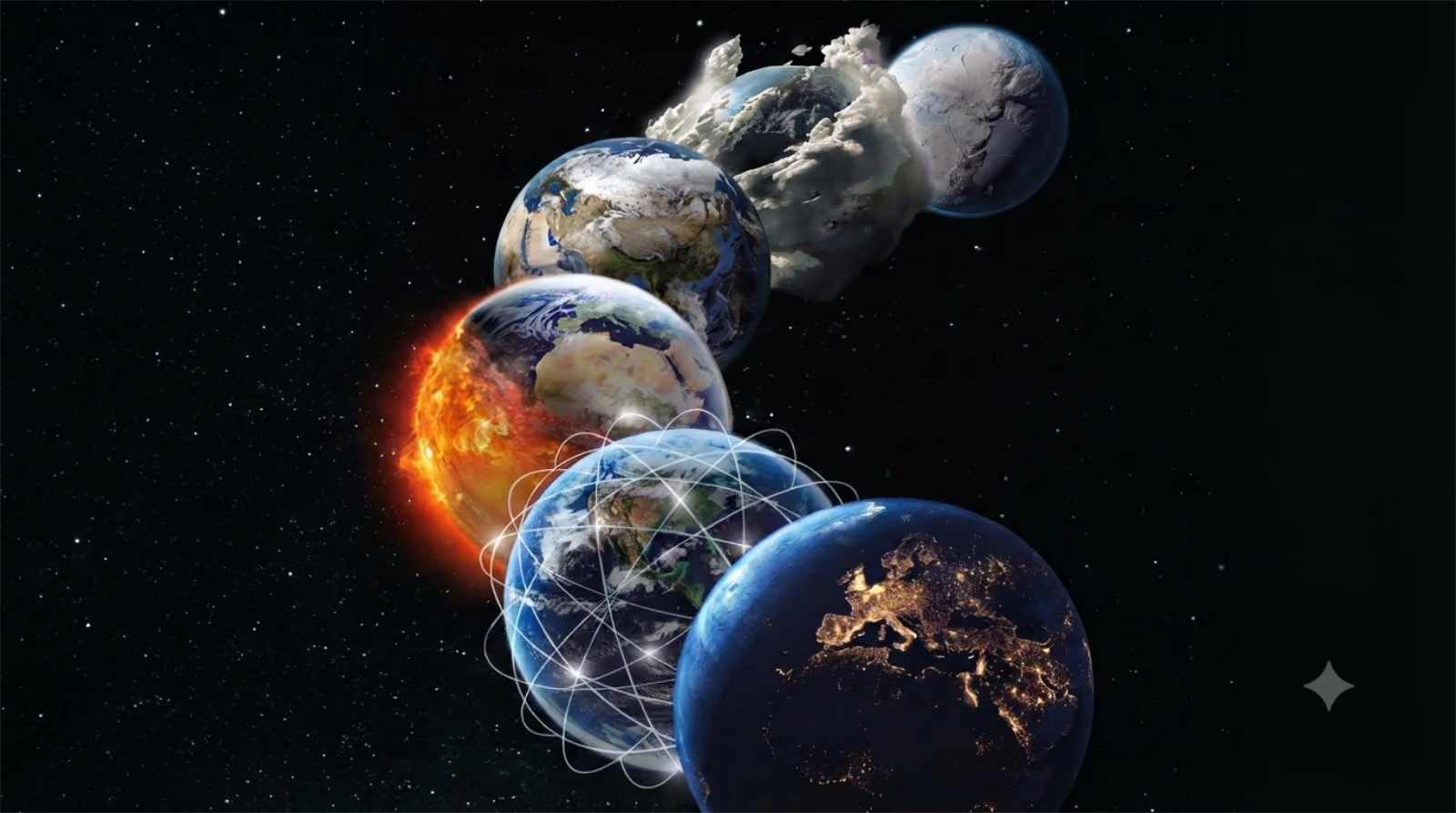
Climate change is real and we're still causing more harm than good. For some countries, the climate is now a question of survival. As the damage grows, governments have to spend more just coping with it: fire protection, building sea walls, rebuilding after floods, propping up water supplies. That money comes from somewhere, so it gets pulled away from things like health and schools.
At the same time, demand for fossil fuels and critical minerals keeps rising, because the digital, higher-consumption life people want runs on both. We've gone from simpler times where we loved people and used things, to now distancing ourselves from each other so we can accumulate more possessions.
Food and water get scarcer.
Australia is one of the most exposed nations to climate change. Extreme weather cost Australian insurers almost $3.5 billion in 2025, thanks to a cyclone, floods and a run of severe storms.
Technological advances and connectivity
Tech isn't just improving, it's dissolving into everything. Cheap sensors, data and connectivity push AI and automation deep into daily life, and the lines between the physical, digital and biological worlds blur. We're living in a science-fiction reality.
Biotech may cure diseases we can't treat today, but the same advances get weaponised.
This report probably took the UK government a year to write, and AI is happening way faster than that, so let's take this with a grain of salt. But the report treats artificial super intelligence as a 2040 possibility. It pictures decisions sliding from a human in charge towards a human barely in the loop. It flags quantum computers breaking today's encryption and a contest over what people believe, run on deepfakes and flooded feeds.
That's already happening.
All that computing power has an energy and water bill. Australian data centres use about 1% of the country's electricity today, and that's tipped to hit as much as 11% by 2035, driven mostly by AI.
Economic transformation and energy transition
Automation and new ways of making things, like 3D printing, are rewiring whole industries. The main risk is speed. If the economy can't keep up, you get disruption and job losses.
Countries are rebuilding their domestic production capacity and that could unwind globalisation as we know it.
The reports say global energy demand will roughly double by 2055. As we move into the AI age with demand for data centres the size of suburbs, that seems like a low estimate. The fight shifts from who's got the oil to who's got the critical minerals and knows how to build clean energy. The reports are blunt about the choke point. China controls the processing and refining of rare earths, and it's not shy about using that.
Australia is the world's largest producer of lithium and a top-five producer of cobalt and rare earths. That's real leverage. But we dig it up and ship most of it offshore to be processed, a lot of it in China, so the money and the control end up somewhere else. Somewhere other than in a sovereign wealth fund that benefits us all.
The reports' warning to fossil fuel exporters is a nudge to diversify. Our minerals are the obvious place to start.

Inequality and pressure on governance
We've never had more access to education, health and information. And yet the gap between rich and poor keeps widening. Tech is reshaping who earns what, wealth pools at the top, and growth is slowing. People can see the unfairness, but a rapidly growing number of people are pointing their finger in the wrong direction. If this all sounds a bit Gary Stevenson, maybe that's because he's on to something?
The reports call this cognitive warfare. Misinformation. Deepfakes. It's all aimed at making you doubt your own institutions. I wonder who would have the motive and means to push this kind of manipulation? There's a thought.
Trust in Australia's national institutions fell from 55% to 48% in a single year, and the sharpest drop was among under-35s and people with a mortgage. Cost of living, thinning trust, a nagging sense the system is rigged. It's happening now, not in 2040. The reports look conservative there.
What to make of it
These reports aren't about predicting the future. They're about making good bets, probable bets, and high impact, low probability bets. It's about recognising things that are near-certain versus what's a long shot.
The reports see people as populations and threats. That's a defence view of the world. We can flip that point of view and look for the opportunities to grab hold of and the possible futures to plan for. Not out of fear. Out of resilience and readiness.
Smart, strategic thinkers should read both of these reports and form your own opinions. Start with Global Strategic Trends: Out to 2055, then the companion, Future Operating Environments 2040.