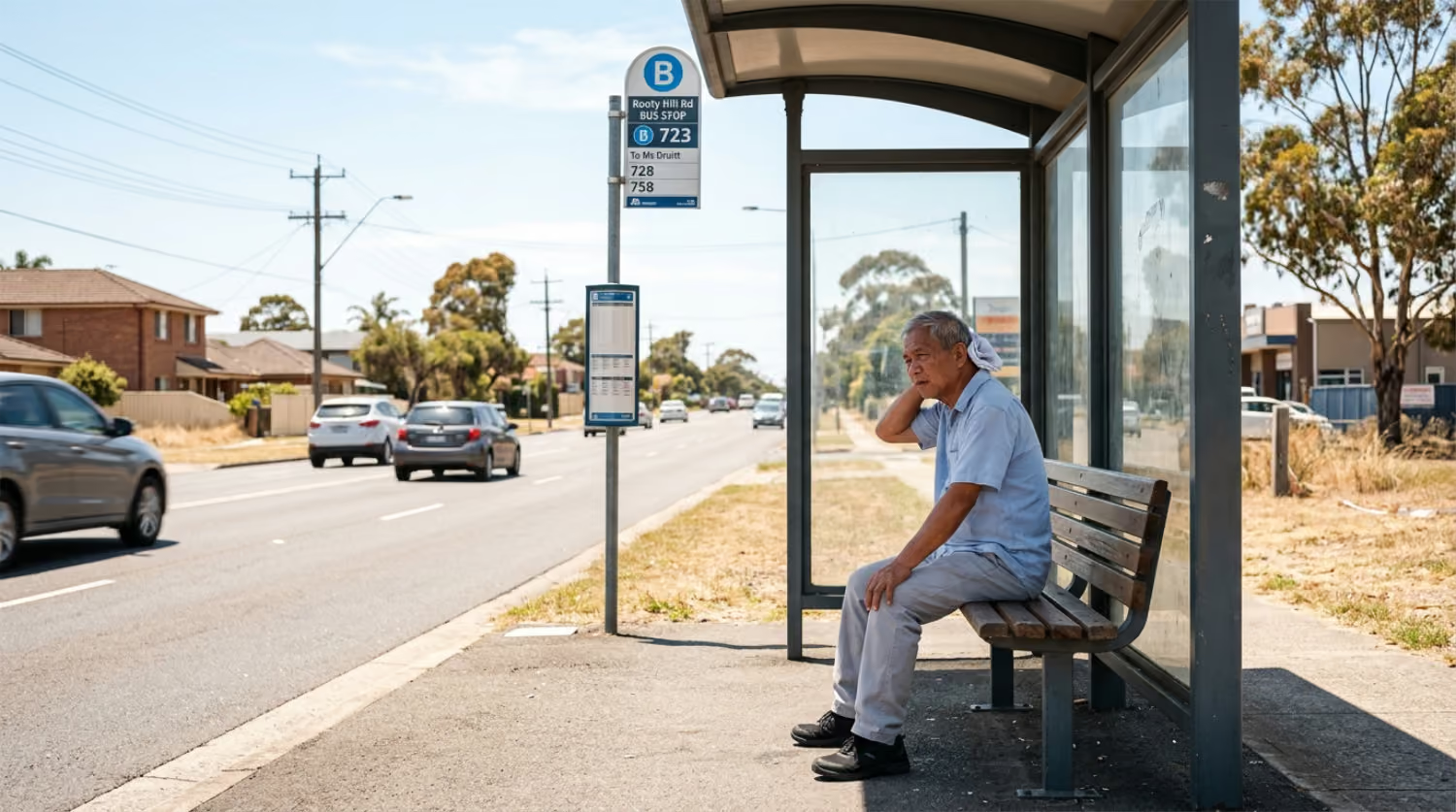
A society under quiet pressure
Six signals this month reveal a society under quiet pressure. Australians are trusting each other less than they have in decades, and a generation of young people can't access the mental health support they need. Mortgage stress is biting hard in outer suburbs while a newly mandated Labor government sets an ambitious productivity agenda. Australian businesses are racing to deploy AI agents without the governance to match. And the country's first comprehensive climate risk assessment has moved the conversation from "should we act" to "what are we disclosing." The moment feels less like crisis and more like accumulation.
Society
Australians don't trust each other the way they used to
The Scanlon-Monash Index has been tracking this for nearly twenty years. Every core dimension, belonging, fairness, civic participation, acceptance of diversity, trust in institutions, has trended down since the late 2000s.1 That's not a blip. It's a direction.
The Bondi Beach attack in December accelerated something that was already moving. A Royal Commission on Antisemitism and Social Cohesion is underway, with an interim report due this month. Australia's democratic consensus is holding, but it's concentrated. It's durable among older, more educated Australians. It gets thinner where educational disadvantage, economic insecurity, and low institutional trust pile up together.2
There's a counterpoint worth holding. People living in cohesive neighbourhoods are 65% more likely to report a strong sense of belonging.3 The national number is declining. The local number can still hold. That gap matters for how organisations think about community investment.
Type: Emerging | Strength: Strong | Rationale: Longitudinal Scanlon-Monash data corroborated by ANU, AIHW, and the Human Rights Commission across independent sources over multiple years.
Technology
Australian businesses are deploying AI agents faster than they're governing them
69% of Australian organisations are now using agentic AI. 61% report improved efficiency. Only 30% are using AI to fundamentally change how they work, compared to 34% globally.4 That gap matters.
Only 22% of Australian companies have a highly advanced model for agent governance.4 That's the number to watch. Agentic AI doesn't just automate a task. It makes decisions, executes across systems, and compounds. Without governance, it amplifies whatever weaknesses already exist in an organisation.
Gartner predicts 40% of enterprise applications will include AI agents by the end of 2026.5 More than 40% of agentic AI projects are forecast to be cancelled by 2027 due to unclear business value or inadequate risk controls. Both things are true simultaneously.
The energy cost is the part most organisations aren't counting yet. AI workloads are power-hungry. For any business with clean energy commitments, the AI build-out and the sustainability agenda are already in tension.
Type: Emerging | Strength: Strong | Rationale: Deloitte primary survey of 3,235 respondents across 24 countries, corroborated by Gartner and multiple Australian industry sources.
Economy
1.3 million Australian mortgage holders are in stress. Rates are still rising.
Roy Morgan's March 2026 data puts 26.6% of all Australian mortgage holders at risk of mortgage stress. That's 1.319 million households, up from 23.9% before February's rate hike.6 The RBA raised rates in both February and March. Markets are pricing in another increase.
Australia's household debt-to-income ratio sits at approximately 185%, among the highest in the developed world. A $700,000 mortgage now costs $400 to $500 more per month than it did in mid-2025.7
Housing costs are the biggest financial concern for 22% of Australians. That's more than double the figure from five years ago.8
The stress isn't evenly distributed. It concentrates in outer suburbs, in households with variable rate loans, and in people who bought at the peak. Those are also the areas most exposed to service gaps. The discretionary spending contraction is already underway.
Type: Established | Strength: Strong | Rationale: ABS primary data and Roy Morgan survey corroborated by multiple lender and analyst sources. The numbers aren't contested.
Environment
Australia's climate risk is now on paper. Boards are required to act on it.
Australia released its first National Climate Risk Assessment in September 2025. It's the most detailed picture the country has ever had of what's coming. More intense floods, fires, and cyclones. 1.5 million more people in high coastal risk zones by 2050. Up to 70% of native plant species facing conditions outside their current climate range.9
The cost is already showing up in the present. Nearly two-thirds of businesses with outdoor workers report productivity losses during heatwaves. The cumulative figure is $6.9 billion every year.10
Mandatory climate disclosure obligations are now in force for large Australian businesses. That changes the conversation from "should we think about this" to "what are we disclosing and when."
For businesses with supply chains, infrastructure, or outdoor workforces, this assessment is the baseline. The question isn't whether climate risk is material. It's whether organisations have mapped their specific exposure.
Type: Emerging | Strength: Strong | Rationale: CSIRO, DCCEEW, and Australian Climate Service primary sources, corroborated by AICD on mandatory disclosure obligations.
Politics
Labor has a mandate it hasn't had in a generation. The question is what it does with it.
Treasurer Jim Chalmers has named productivity as Labor's defining second-term priority. The Productivity Commission has been asked to develop five reform pillars and, for the first time, sought pitches directly from the public.11 500 submissions came in. That's a signal of genuine intent, or at least genuine process.
Labor's landslide all but guarantees a third term after 2028.12 That's an unusual amount of runway for an Australian government. Income tax cuts kick in from July 2026. Bulk billing reforms are underway. A housing program targeting 100,000 homes for first buyers starts construction in 2026/27.
The counterpoint is real. Housing targets without immigration moderation don't add up. Productivity reform is easier to announce than to deliver. But a stable government with a clear mandate and a decade of runway is a different operating environment for business than what came before.
Type: Emerging | Strength: Moderate | Rationale: Policy agenda corroborated across multiple sources. Moderate rather than strong because policy intent and delivery are different things, and the reform history is patchy.
Health
Nearly a million young Australians can't get mental health support. The system wasn't built for this.
1.25 million children and young people need mental health support in Australia every year. Current services will reach 13% of them by 2026. For children under 12, the figure is 3%.13
Scaling to meet demand would cost $1.94 billion annually. That funding doesn't exist.
School-based resilience programs work. Research published in March 2026 confirmed effectiveness, but also confirmed that which components matter most, how long benefits last, and what makes delivery succeed in schools are still unclear.14 The evidence base is being built in real time, while the gap keeps widening.
The downstream consequences reach into everything. Workforce participation. Educational attainment. Healthcare costs. Social cohesion. The things already under pressure. This isn't a mental health sector problem. It's a whole-of-community problem that hasn't been framed that way yet.
Type: Emerging | Strength: Strong | Rationale: BFB Labs analysis of published government data corroborated by Emerging Minds and peer-reviewed school intervention research.
What we're monitoring
Labor's Digital ID expansion is worth watching closely. Mandatory use across all federal services is potentially on the table by mid-2026. If it proceeds, it changes how Australians prove who they are when accessing government services, and raises real questions about privacy, inclusion, and what happens when the system fails. We'll be tracking the legislation and the public response next cycle.
Signal sources
- The New Daily, 'Why modern Australia is less socially cohesive and how to repair it'
- Australian National University, 'Social cohesion and support for democracy in Australia'
- AMES Australia, 'Social cohesion holding up in Australia, survey finds'
- Deloitte Australia, 'The state of AI in the enterprise 2026'
- CFO Tech, 'Australia in intermediate phase of agentic AI adoption'
- Lagos Financial, 'Mortgage stress 2026: a practical guide to protecting your home and finances'
- Kalkine, 'Interest rates and cost of living crisis in Australia 2026: impact on investors'
- Canstar, 'Housing costs Australians top financial worry for 2026'
- Department of Climate Change, Energy, the Environment and Water, 'Assessing Australia's climate risks'
- CRV Science, 'Australia's 2026 climate crisis: heatwaves, fossil fuels, and policy failures'
- The Conversation, 'Labor has the chance to do something big in its second term. What policy reforms should it take on?'
- SBS News, 'The many ways Australia will change under Anthony Albanese's second term'
- Pulse+IT, 'Understanding the gap: Australia's youth mental health crisis'
- Emerging Minds, 'Highlights in child mental health research: March 2026'